
Kilimanjaro Journal
“There, ahead, all we could see, as wide as all the world, great, high, and unbelievably white in the sun, was the square top of Kilimanjaro.”
—Ernest Hemingway
Nearly 23 years ago, on October 9, 2003, alongside three climbing brothers, I summited Mt. Kilimanjaro, up and across the treacherous Western Breach, to 19,341 feet—to the top of Africa’s highest mountain, the highest free-standing mountain in the world.
Here is my original and unedited journal—here is how it happened . . .
—David Morey
September 29, 2003: As Delta 80 lifts gingerly off JFK’s runway I realize this journey is about gaining altitude and going higher. The day before, I almost take off—grounded by the chronically unfriendly airline employee who informs me of a little-known fact in our post-9/11 world: You need a U.S. passport that’s valid for at least six months after you return from Africa.
Dejected, not defeated, I accept this as some kind of pre-mountain mini-test and remind myself of the lesson every frequent traveler learns too often: Roll with the punches! The trick is to work the problem, not stress it. A few calls—and we’re back up the next night. Ready to gain altitude. Ready to go higher.
I find myself thinking back: The insanity of climbing the world’s highest “free-standing” peak first arrived on a very ordinary June day.
My friend and long-time business partner, Joel McCleary, blurted the challenge: “Are you with us to climb Kilimanjaro?” Joel’s contagious enthusiasm didn’t help.
In fact, I’d always wanted to climb Kilimanjaro. I’d heard stories of the great mountain. I’d heard that some climb it to defeat mid-life. Others to cleanse their soul—to find catharsis. But I knew I’d try and climb Kilimanjaro simply to conquer the challenge—because it’s a recurring pattern inside my own personality.
Of course, some say: “You’re crazy!” “You’re nuts!” “You’ll get sick!” And ask suspiciously: “Who talked you into it?”
But over the last months, listening to these doubters, I learn again that one is often on a noble journey at just the moment some insist you’re not. Beware advice to become a prisoner of habit. Beware advice not to do something.
Life reaches higher than that. Life aspires to the passion of conquering fears, breaking habits and turning the routine into the unreasonable. It’s about attacking the adventure that makes us real. It’s about transcending dreams. And going higher.
Ignore the doubters. The unreasonable triumph.
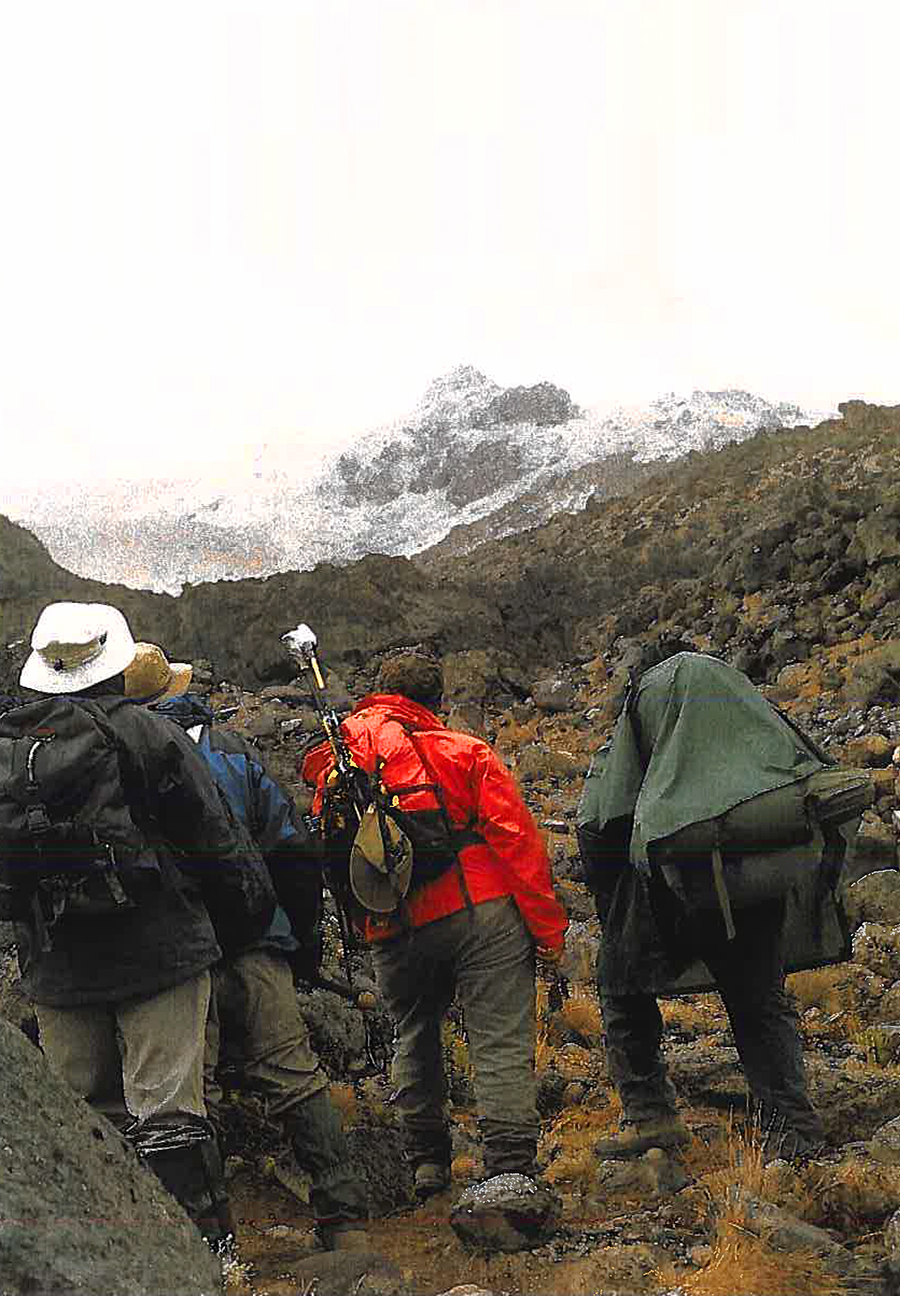
So, it’s Kilimanjaro. At first, the idea is just scary. Can I do this? Can I get into shape? Can I win the lottery by not pulling an altitude sickness ticket? Slowly, however, something begins to approach. A familiar friend. Incrementally, day-by-day, I find myself visualizing actually doing this—each day harder, higher, more breathless, closer, and, finally, to the top.
I feel better. My Korean friend, Mr. Cho, a three-time Kilimanjaro conqueror, mentions over a fancy late-night French dinner in Seoul’s Shilla Hotel that I should be ready to run seven-minute-mile marathon pace. Silently, I vow to work out harder—even if I’m unsure whether Mr. Cho himself has ever actually run this fast.
Mr. Cho, however, says something that sticks immediately inside my brain and that I know will be drawn upon along this journey: “Kilimanjaro is more about the mind than the body.”
As for the body, over the last three months, training has been an epiphany. First, it immediately triggers the muscle memory of my athletic youth. Quickly, I seem to look, feel and train better—as if some Fountain of Youth for the ex-athlete rests mysteriously inside the strange, new, black, metal machines at the gym.
Second, my two “coaches,” ex-high-school and Villanova world-class track coach Marty Stern and fitness trainer and Florida fishing guide, Eric Bass, make important points:
- “Question: If a guy in a bar challenges you to a $50,000 bet to run a 50-yard dash in one week, what’s the best way to train? Answer: Do nothing. Victory often comes from not getting hurt.”
- “Most people, in fact, get hurt training for a marathon. Actually running a marathon, by contrast, is relatively easy.”
- “Use the new, modern, high-tech machines to supplement running the roads, which are simply too stressful over the long-term.”
- “Train specific to your challenge—in this case hiking up a 19,340 foot near-vertical mountain—with long hikes, high reps and lots of rest.”
Over two months, after building a running base, I buy a “pulse meter” that looks like it’s made for NASA astronauts and re-learn my body’s athletic rhythms.
These strange, new, metal machines—the “Elliptical Stepper,” “Stair Climber” and “Treadmill”—are like working out on piles of cushions. Gone are the stresses of running. So, over weeks, I watch my pulse go up and slowly recover, better and better, stronger and stronger.
One day, I go to work out with Eric Bass. Aware we’ll test some limits, I work up to a 30-minute, 30-second-on, 30-second-off Elliptical Stepper regime on a steep slope at high speed, with lots more after that. As my pulse hits a still-comfortable 175 and slowly backs down I somehow know that I’ll be ready.
The next day, impressed, Bass admits to sneaking back to the gym to try the same workout. Later that week, he declares: “You’re in pretty good shape.”
Over several weeks, I ride high hills on a too-small bike with former national-champion fencer Edgar House, go over workouts with Marty Stern and Eric Bass and get ready for my biggest test: the physical.
On August 5, I apprehensively visit my 80-something-year-old Park Avenue Doc, Jacob Bornstein, for a mandatory pre-climb physical. Doc spends hours with me, initially asking plaintively: “Why are you doing this?” Satisfied, he reads briefing papers with me to prescribe anti-altitude medications while checking every possible vital sign.
Then, he pronounces me in “superb” physical shape—blood pressure, pulse, weight, cholesterol all great, as he takes me into a “Zen” state to watch approvingly as my pulse drops five and ten and then fifteen points.
Doc gets it. He thinks this is a great idea and revels in the fact that my lunges score 102% on his antique-looking VO2 meter. He’s the anti-doubter….still practicing in his 80s, taking courses to stay current, ready, always, to climb higher.
Later, I visit my “Tropical Disease” doctor on Fifth Avenue, Kevin Cahill, one of the foremost authorities on Third World travel and preventative treatments. Short, bubbly, highly confident, Buddhist scholar and anti-land mine activist, Cahill looks disappointed to hear I’ve only come in for routine shots and pills. Secretly, I note, he almost wishes I’d contracted some incurable disease that he could now famously defeat.
More encouragingly, Cahill talks about the climb. In fact, he did it himself when he was in his early 30s. “After three months of living in the mountains,” he boasts, “they made me an ‘Honorary Sherpa.’” Another anti-doubter.
For preparation, Mr. Cho recommends I contact his friend and long-time climbing guide, Ian Wade, Director of Outward Bound, three-time Everest conqueror and a climber who has gone eleven times to the top of Kilimanjaro.
Wade talks preparation: And worries over our route, the very difficult Western Breach where, once, “He watched a body being brought down.” Pressed, Wade offers cryptically: “The Western Breach is an extremely difficult route to defend.”
When I ask Wade what exactly this means, he says dramatically “At some critical point up the Western Breach the possibility of retreat doesn’t exist.”
Wade adds: “On the Western Breach route, you usually sleep one night at a very, very dangerous and critically-high altitude of 18,300 feet.” But, he says something else that’s more calming: “People tell me climbing Kilimanjaro is the hardest thing they’ve ever done, harder than running a marathon, harder than having a baby, harder than any pain they’ve ever endured. …but I didn’t find it that hard.”
Another anti-doubter.
As I get ready for ten days of Colorado training there are some interesting moments:
- Marty Stern “getting lost” inside Hemingway’s Snows of Kilimanjaro: and Other Stories.
- Endless trips to New York City’s Paragon, Sporting Goods Store Hell, to meet yet one more salesman who not only has no idea what he’s talking about—but is out of everything he incorrectly recommends.
- The contrasting discovery of a small Wall Street store called “Tents and Trails,” inside the very shadow of Ground Zero on 9/11’s second anniversary, wherein friendly salespeople know exactly what you’ll need to survive—and have it.
- The Eric Bass-Tony Robbins-Lance Armstrong two-breaths-in, three-breaths-out oxygenation regime that seems to work at moderate altitudes.
- The amazing proliferation of pills, books, maps, boots, clothes and equipment that overflow now from bags into pile after pile.
- The ludicrous scenes of me donning subarctic clothing inside my already warm Washington, D.C. condominium on a very hot August day.
- Joel’s mischievous eleven-year-old son poetically renaming the mountain:
On my way to Colorado with a girlfriend, I know the next ten days will be the real work. To climb at altitude—you have to train to climb at altitude. Simple….smart.
We’re staying at Telluride’s luxurious Peaks Resort, during the film festival. Through Durango, after typical flight delays, we drive along the twisting, skyscraper mountains of this most beautiful state. One day, we gently acclimatize. On another, we work slowly up to 12,500 feet, hard at first, then easier. On a third day we “scramble”—pull up onto rocks with our hands. Then, after a rest day, on 9/1, [hike easily and steadily up to 13,500—to a strange-looking ghost town called Tomboy. I’m ready.
And after more workouts, and rest, on 9/4, I go up 15–20 miles to 12,500 feet—narrowly missing my actual destination: Engineer Mountain.
Then, on 9/6, I start late after an early-morning mountain race and work up to 13,900 feet, very controlled, when, only meters from Sneffels’ summit, it begins, very dangerously, to thunder, lightning and hail—HAIL! Wet and worried, I retreat to later climb higher mountains—quickly retrieving my lucky hat and sliding and skiing down the wet, icy, ominous and steep scree slope on which one small mistake can end instantly two months of training.
But I don’t feel this altitude. And I write in this journal that my first actual summit will be Kilimanjaro.
Two days before leaving, people are beginning to act nicer to me now; they’re even looking at me nicer. It’s as if I’ve become suddenly more popular and charming—or developed some tragic and incurable disease. Others simply sound serious. ..nervous…worried.
Packing for Kilimanjaro is like packing for the moon—planning, packing, re-packing, organizing, assembling clear plastic bags of increasingly thicker clothing that say with a big, bold, black magic marker: “-6″…”-3″…and most dramatically….”Summit.”
Buying anything less than the best gear is not an option. As former Disney executive, Larry Murphy, a Kilimanjaro veteran, casually summarizes: “Your equipment is your life!” And I’m ready: From a Zero Degree Western Mountain sleeping bag to a Patagonia Synthetic Down Jacket to Leki Makalu Poles to Black Diamond Gloves to Cebe 4000 Glacier Glasses to an Osprey Pack and Scarpa Hiking Boots.
And the boots, the boots deserve very special mention—because they’re like guns to a gunslinger. Literally, your life depends on your boots. And from the time I first walked down a slanted board at Sporting Goods Store Hell, Paragon, I knew these new, green, Italian six-shooters would serve me well.
September 30, 2003: Jet lag’s familiar numb creeps inside as I enjoy two hours of “half-sleep,” reclaim and check gear in Amsterdam, and relax inside KLM’s lounge filled with tall blonde women in blue suits. Already, my stomach is queasy—so I chug milk and eat biscuits. At the gate, I meet Mac and Andy, who, even now, looks tired, and watch Joel stride confidently into First Class.
The flight is easy—I suppose worth the hefty First Class difference—and I’m silently glad for the travel experience that allows me to fly easily, comfortably, restfully.
We arrive to Kilimanjaro Airport’s friendly chaos. Andy, our fourth partner, is a former Penn crewman, whose trip in the plane’s back row helps him look like he’s just finishing, not starting, the climb.
Together, we ride to Key’s Hotel through clear, clean African air and beneath a sky that seems blacker, more mysterious and more powerful than it should.
October 1, 2003: Two tiny, white Ambien sleeping pills earn me a hard-to-remember 8 hours of sleep. My stomach is better and breakfast is good. For the first time, a tour of Moshi brings our four “Team Underdog” members together—trading gallows humor about the climb to come. We relax.
This afternoon, sipping tea, after organizing my climbing “kit” yet one more time, I chart with Joel our daily itinerary, altitude gain and hours of hiking.
As it stands, Day 6, 7 and 8 are the entire Ballgame—with Day 8 representing the dangerous and very difficult “point-of-no-return.” Now, I find myself imagining our guide looking back to us and asking, only with his eyes, the existential question: “Are you ready?” And then, each of our thumbs point upwards, affirmatively, with conviction to where we must go.
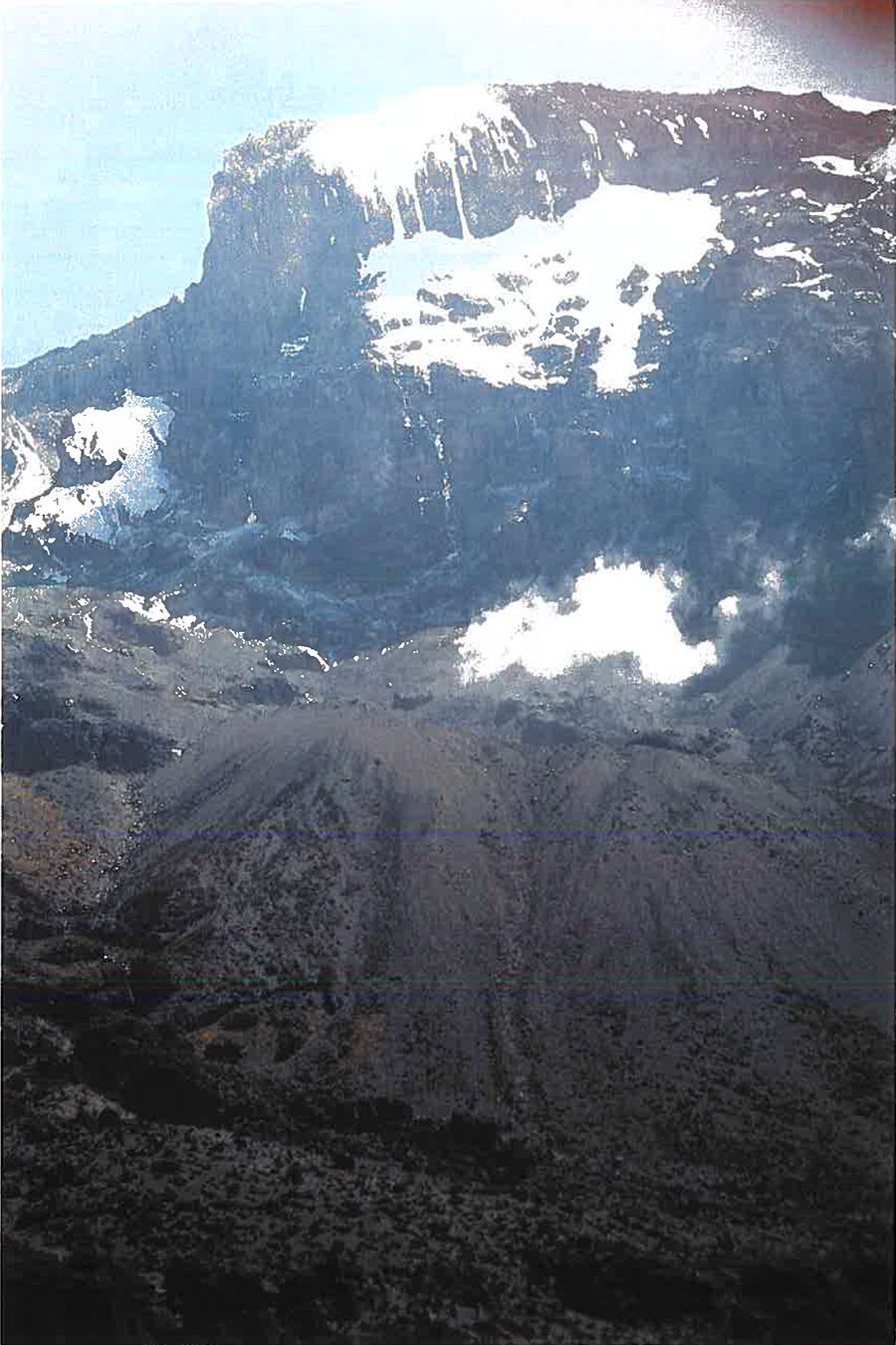
“Our Chart”
Day | Date | Camp | Alt. Gain/Hours | Alt. |
1 | 10/3 | Mt. Mkubwa | 2,000/4 | 9,170 |
2 | 10/4 | Shira | 2,330/8 | 11,500 |
3 | 10/5 | Shira | 7100/4 | 12,200 |
4 | 10/6 | Baranco | 1,800/7 | 12,675 |
5 | 10/7 | Baranco | 500/5 | 12,675 |
6 | 10/8 | Lava Tower | 2,275/7 | 14,950 |
7 | 10/9 | Arrow Glacier | 1,000/3 | 15,925 |
8 | 10/10 | Crater Summit | 2,445/7 | 18,370 |
9 | 10/11 | Summit! | 1,000/3 | 19,340 |
October 2, 2003: Awake after a second deep, double-Ambien night’s sleep, I remember vaguely dreaming of getting up and going to the bathroom, but who knows if it really happened. At breakfast, with two groups preparing to leave base camp, it reminds me of a pre-game locker room. All of us in our own way are getting ready:
- Joel: Is alternatively serious and buoyant, reminding us consistently that he’s the only man in history to begin to get in shape by climbing Kilimanjaro.
- Andy: Falls into comforting stories from the 1970s and reminisces about Coach Ted Nash and the hardest “ERG” sessions he ever did as a member of Penn’s Freshmen Crew Team.
- Mac: Begins popping his beloved Diamox on his way to a serious 750 milligrams a day.
For my part, I feel ready, eager, over-rested from ten days of a cold, shorn now of aches, and wanting now simply to feel the early relief one steals from beginning any task. Like an ancient African warrior who listens intently of stories of another village, my ears perk intently to alternative reports of our fate: “It’s a manageable long walk.” Or: “It’s extraordinarily grueling.” I hear only the former.
The day before we hear the story of a 22-year-old Lance Armstrong-look-alike, who “blew-out” at 15,900 feet when his guide, anxious to earn a day’s extra fee, pushed him too fast. We soak up this lesson even as we admire how fit this guy still looks.