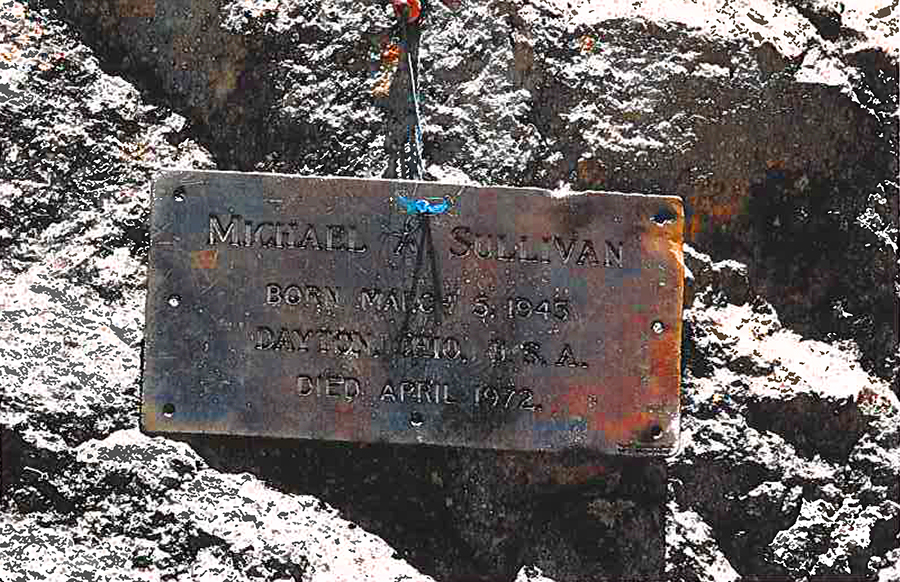
Kilimanjaro Journal
Page 2

Page 2
This morning, for the first time, we meet our guide, Erick Massawe, in whose hands much of our fate rests. Erick admits, almost whispering, to climbing Kilimanjaro 198 times—with what he cryptically calls a near “perfect” record. He looks steady, understated, modest and serious. All good.
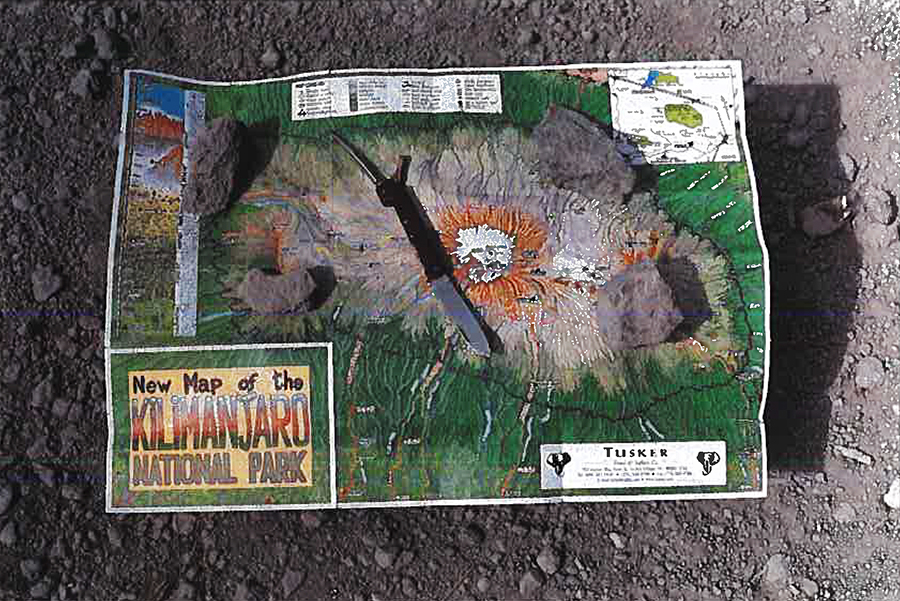
Helpfully, Erick delivers our pre-climb briefing. As he does, Andy, very casually, pulls out a “Bonsa” knife that he’s owned for 37 years. The knife has a 4-inch blade at one end and a 5-inch “marlin spike” at the other, both made of German stainless steel, with a brass-casing covered in some type of maroon hard-resin. Andy jokes that he’s prepared for any oxygen-deprived mental aberrations that his fellow climbers may exhibit.
And Erick stares at, then holds, this long, beautiful “Bonsa” knife as if it’s been beamed into his hands from another planet.
Afterwards, the four of us eat lunch in the shadow of another group of climbers who have just summitted the Western Breach. Through celebratory beer, photos and unhelpful “what-if” questions, I grow to genuinely dislike these guys. Having put it behind themselves, they seem oblivious to what’s ahead of us.
Later, however, after an easy walk, after sitting on the hotel porch to watch Tanzania walk by, mostly for the water that over a billion people all over the world fetch every day, I sit down to actually talk to this Conqueror Group. They call the Western Breach “doable”—nearly vertical and extremely scary, but doable. “Boredom,” they warn, will be our hardest enemy: Every night driven away from the cold and into our tent’s relative warmth.
“Defeat boredom,” they advise, “with books, stories and cards.” And I quickly find myself imagining old, black-and-white war movies where POWs sit solemnly in the middle of a dull, painful, never-ending monotony.
After one last shower, with Joel sick in the other bed, I settle into one final night of Tanzania’s version of civilization. The mountain comes tomorrow.
October 3, 2003: We’re on the mountain now. A slow, bumpy, dusty jeep ride reminds me of the thousands of nervous journeys inside some yellow school bus to an athletic contest that, at the time, seemed like life and death. Now, we four ride to Kilimanjaro with a similar, but more palpable, feeling of life and death—passing strangely by waving children and glimpsing a pain hidden behind their dark, deep-set eyes.
We begin at a lush, green forest base and, slowly, wind our way up trails that seem already steep. First, I have some trouble breathing, adjusting my pack and poles and getting even a drop of water from my new and fancy Platypus. It’s like scuba diving—where you must know every inch of your equipment to be safe. Soon, adjusting, I’m barely breathing hard. And I imagine imitating perfectly Erick’s slow and steady upward stroll.
Three hours later, we hit camp—hot tea and tiny, pretty yellow tents greet us after an almost comfortable hike that takes us to 8,950 feet.
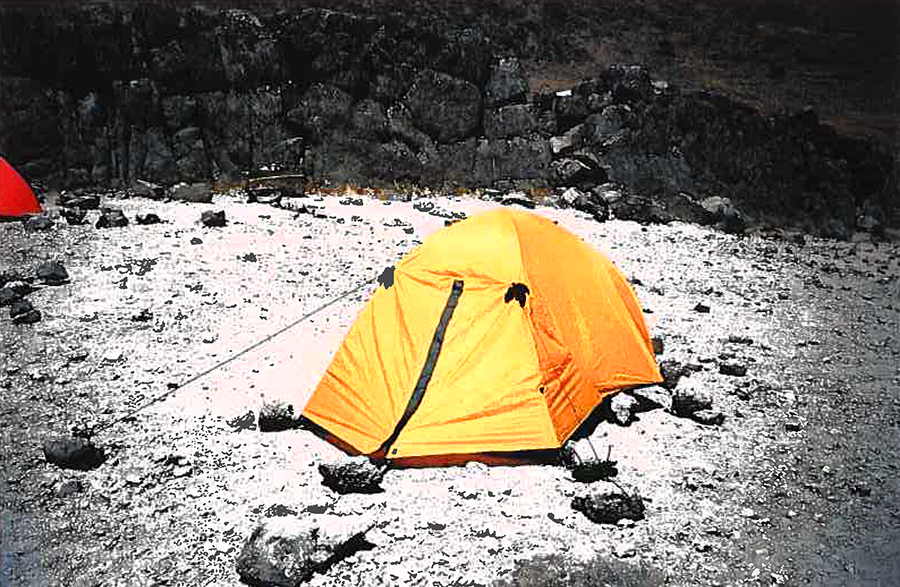
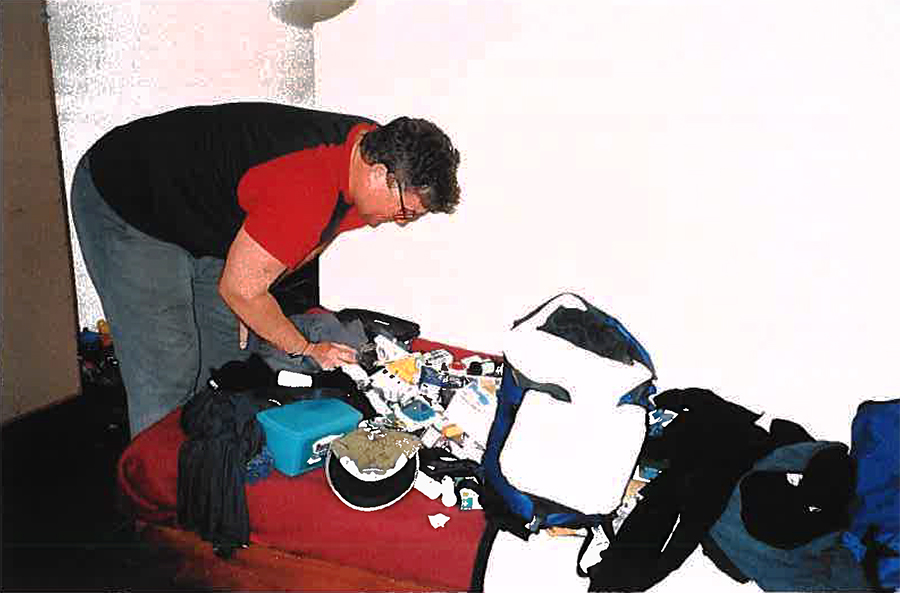
Immediately, the big challenge is getting into the tiny, pretty yellow tent before 220-pound Joel—staking out precious space, organizing gear and preparing. In fact, almost unconsciously, we all begin creating little life systems and routines that we’ll try and recreate each night.
Already, there are interesting sights:
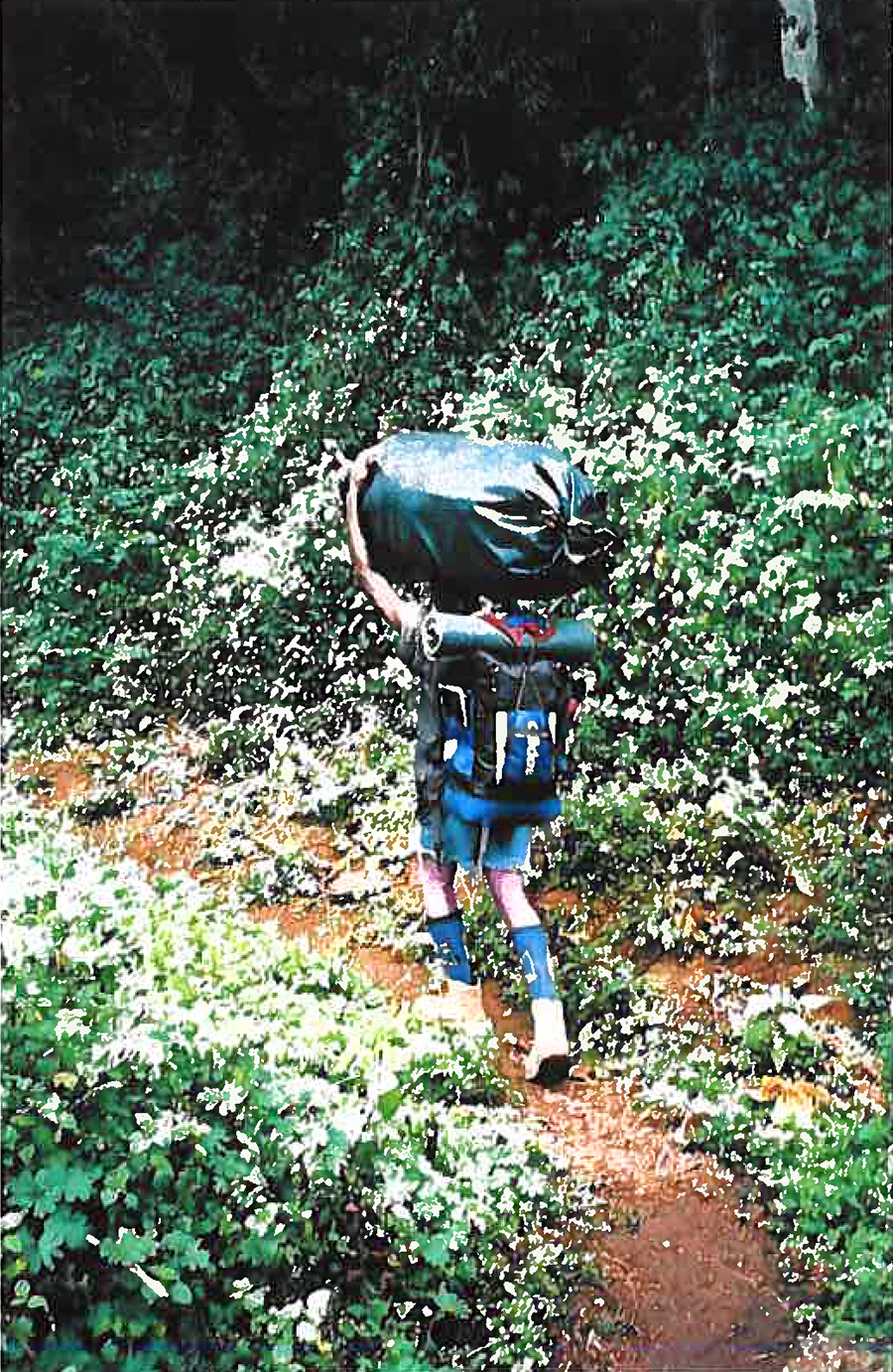
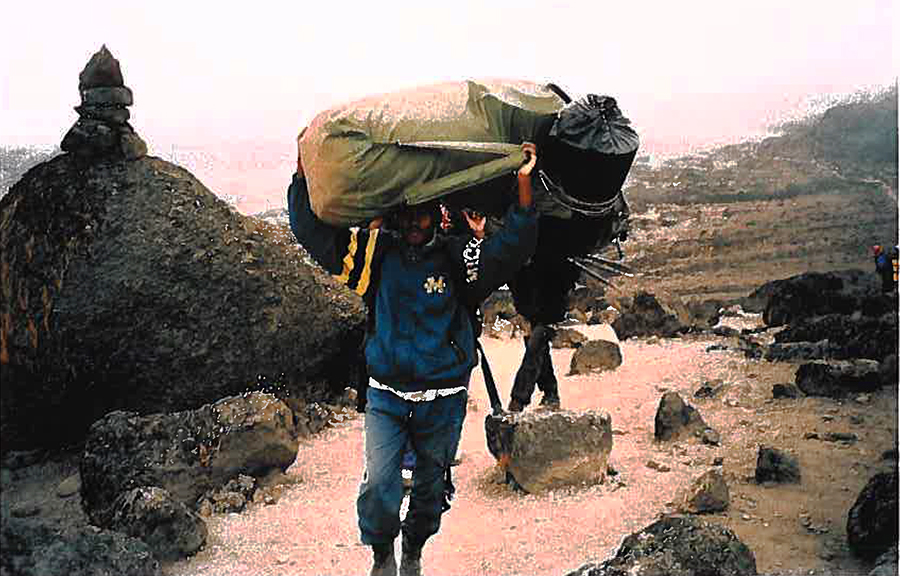
And, by the way, the porters are amazing. In addition to head guide Erick, our group consists of an assistant guide, cook, assistant cook and twelve—twelve—porters. Each day, these twelve porters dutifully follow us wearing a strange array of donated, mismatched clothes, even rubber flip-flops, lugging atop their backs and heads most of our gear: tents, cooking equipment, ten days of food, emergency oxygen and first aid supplies.
Each day, for the paltry sum of $3.50, before tips, the average porter begins with over 75 pounds—three times the weight of our own daypacks. Then, one by one, in less than an hour, nearly trotting, porter after porter overtakes us and, high above, breaks camp and begins cooking well before we ascend to what for the next ten days is home.
October 4, 2003: Last night was tough. Up with jet lag and a bad cough, I fight hard to stay cool inside the culture shock of living in a tent. Somewhere in the middle of insomnia and simply worrying if I can breathe, I remember the last time I slept in a tent was with Hank Martin when I was 12. Thank God for adult tent mate, Joel, who happens to have 500 mg of Cipro and an Ambien.
Planning medications into four hours of sleep, I survive and wake up feeling good after thoughts of family and friends rock me ultimately to sleep.
Now, this morning, I’m better and stronger—the internal athlete slowly returns. We hike comfortably—4 on a scale of 1 to 10—for 7 hours to 12,000 feet and back to 11,500 feet to sleep. In fact, I’ve been to this altitude before in Colorado; and this helps, as do the three aspirins that cure the beginning of my altitude headache. Sitting for dinner, we can now begin to see Kilimanjaro before us, and it looks awesome and mighty. And who could describe such a sight better than
Ernest Hemingway:
“There, ahead, all we could see, as wide as all the world, high, and unbelievably white in the sun, was the square top of Kilimanjaro.”
October 5, 2003: I sleep for 7 hours. For me, the cold tent-life and 7:00 p.m. bedtime are harder than the hiking.
I feel groggy, but good. Erick gives me encouraging news as my blood oxygen percentage/pulse reading is 89%/108. More importantly, he convinces me that my persistent cough is not so bad and that, if necessary, you can take medicine up to 14,000 feet—one guy, he remembers vaguely, made it coughing all the way to the Summit.
Today, we hike up, steady, with sensitive stomachs, to Shira I at 13,000 feet. We’re feeling good.
At dinner, at 6:00 p.m., the hot soup tastes as good as the cold air feels bad—driving us rapidly into our tiny, pretty yellow tents and puffy subzero down sleeping bags.
Again, the night moves along with discussions about what pills I should take to defeat cough and insomnia. Two nights before, I take 3 Aspirins, 1 Diamox, 2 sips of cough medicine and 2 Ambien—and survive. This sub-14,000-foot regime seems to work. I sleep 7 hours.
October 6, 2003: We hike today seven-and-a-half hours from 13,000 feet to a high of 14,500 feet, then down, then up, and then down again to our Baranco Camp at 13,000 feet. Hiking across this moon-like surface, I keep thinking of a movie I once saw: “Robinson Crusoe on Mars.” Like the space adaptation of Daniel Defoe’s Crusoe character—a futuristic, tough, shorthaired, short-sleeved astronaut—I’m amazed at how quickly we adapt to this extraterrestrial hiking, survival and perpetual one-step-ahead planning.
“What will we need next?” “After that?” “What if it rains?” “Snows?” “What do we need to sleep?” “What do we need to wear tomorrow?”
“What about the day after?”
It’s amazing, too, how dirty and dusty everything becomes. It’s like, I imagine, being a U.S. soldier in Iraq: There’s no chance of defeating the constant invasion of dust—everywhere on everything—and we soon wisely surrender to the enemy of filth.
Now, as we hike along this moon-like mountain I reflect on our guide and fellow hikers:
Today, as we break back into Baranco, I’m surprised, too, by the clarity this stark challenge brings to one’s mind—helping and treating others well, loving loved ones, enjoying every hidden ounce of life. Through the rain and hard descent I feel great. Like confident warriors, we all decide to accelerate our attack and go for Lava Tower and 14,900 feet tomorrow. Time for my last pre-14,000-foot Ambien and, I hope, a good night’s sleep.
I’ll try to dream of loved ones rather than our battle in a few days with the Western Breach.
October 7, 2003: We wake feeling refreshed—7 or perhaps even 8 hours of sleep. Somewhere in the middle of the night, I dream I’m making a presentation to my client, Nike, and that I’m rooming with another client, billionaire David Bonderman, at a hotel in a town at the bottom of the mountain. I can’t believe how great the warm shower and room service are. Then I wake up.
Our “readings” are strong—mine 88%/108. Thankfully, yesterday’s late afternoon rain is absent—I can’t even imagine enduring many rainy days on this mountain—and we begin a steady four-and-a-half-hour trek and climb to a very high 15,200 feet, to camp at Lava Tower. We all feel great. And it’s time for water and the gaming obsession I’ve learned my fellow climbers and former boarding school kids harbor: “Hearts.”
October 8, 2003: I roll about wrestling to about two in the morning, try one last pill, and sleep a good five more hours. My readings are very good—83%/87. I’m strong. And now, for fun, I even try to imagine I’m Seabiscuit as I hang behind Andy and save my energy for when I’ll need it, for the kick, for the peak—for the finish line.
As we walk one and a half hours up to the beautiful Arrow Glacier, I reflect on the simple power of organization—again, your daypack becomes something like a liquid-scuba-rig as you breathe in water through a tube, a “Platypus,” and swig energy drink from hanging canisters. Everything has its place in pack and pocket—medicines, sunscreen, power bars, bandages, film rolls, glasses, back-ups, double-back-ups. It’s like going to another planet.
At lunch, our readings remain strong although Joel’s drop a bit to 78%/121. Yet he’s ready: He and I, our whole team, can begin not only to imagine but also to literally taste the Summit. At 3:00 a.m. we know the Western Breach will scare us. But we can taste what lies above that fear.
At lunch, two days ahead of schedule, like generals planning war, we review the pros and cons of a midnight Breach and Summit attack: