Kilimanjaro Journal
Page 3

Page 3
Tonight, it will be the Western Breach at midnight. And the day will be spent relaxing, organizing and getting ready.
It’s now that you forget about those who said you were crazy to do this—the doubters. For perspective, however, this is not a sport for the sane.
The night before, as Joel reads from a mud-stained mountaineering book, I remember particularly the passage about how many ways there are to die on a mountain: Death by freezing, death by falling, death by avalanche, death by starvation, death by exhaustion, death by rock fall, death by ice fall and death by the invisible aggression of altitude sickness, which can kill the brain or heart. Falling, this book reminds, is the ever-present option. Gravity doesn’t forget itself or go temporarily off duty.
The writer Paul Claudel said it perfectly: “We lack wings to fly, but we always have strength enough to fall.” But fall we will not. For as dangerous as climbing, and this climb, is, we are ready and safe and sure. And the reason you go up is to get to the peak of the challenge. Remember, most religions constitute up as the greatest place to be. So we will rise high to the peak tomorrow, across the Breach and beyond our anxieties and fatigues and physical aches. Up tomorrow.
October 9, 2003: It seems like I’d just fallen asleep for only one minute—a cruel fact later confirmed by tent-mate Joel—when the call came at 11:00 p.m. I’d like to say the Henry V Shakespearean verse came to mind: “Once more into the breach, dear friends,” but the truth is I was simply groggy. Despite obsessively laying out my gear the night before, in the freezing temperatures of 15,900 feet, it takes me a very long time to get it all on and organized for our upward attack.
Putting back precious water that leaks when our assistant cook forgets to tighten my Platypus cap becomes a major chore on the low intelligence of no sleep. Sipping tea and eating a cracker at 11:40 p.m., we are very, very serious. No joke seems appropriate. Then we begin. Slow, easy steps.
The night is bone-chillingly cold, and later my sub-zero Black Diamond gloves will let my fingers become alarmingly cold—this is not the time for wearing any thin inner shell, because, when it counts, I’ll need to grip holds on rocks on which I know I must depend.
Obsessively, I keep reviewing my equipment. I keep asking myself where it is and how not to drop a glove or pole, which has happened. I keep asking myself where to get what I need when it really counts: Extra lights and batteries close to the body, the Platypus mouthpiece snug in its thermal insulation, so it has a fighting chance against freezing in this arctic temperature. First, we are in the scree. Never mind that it is frozen and easier to climb. It is a nightmare of a challenge. Up two steps.
Down one. Up three. Down two. I find myself digging in with my toes or gripping snowshoe-style with the sides of my boots, and using my upper body and poles as much as my legs; and I move slowly, slowly higher. Sometimes, quickly, I look up—I’ve vowed never on the dangerous, exposed Breach steps to look down—and we have several Empire State Buildings of nearly vertical height to go. Up two. Down one. Up three. Down two.
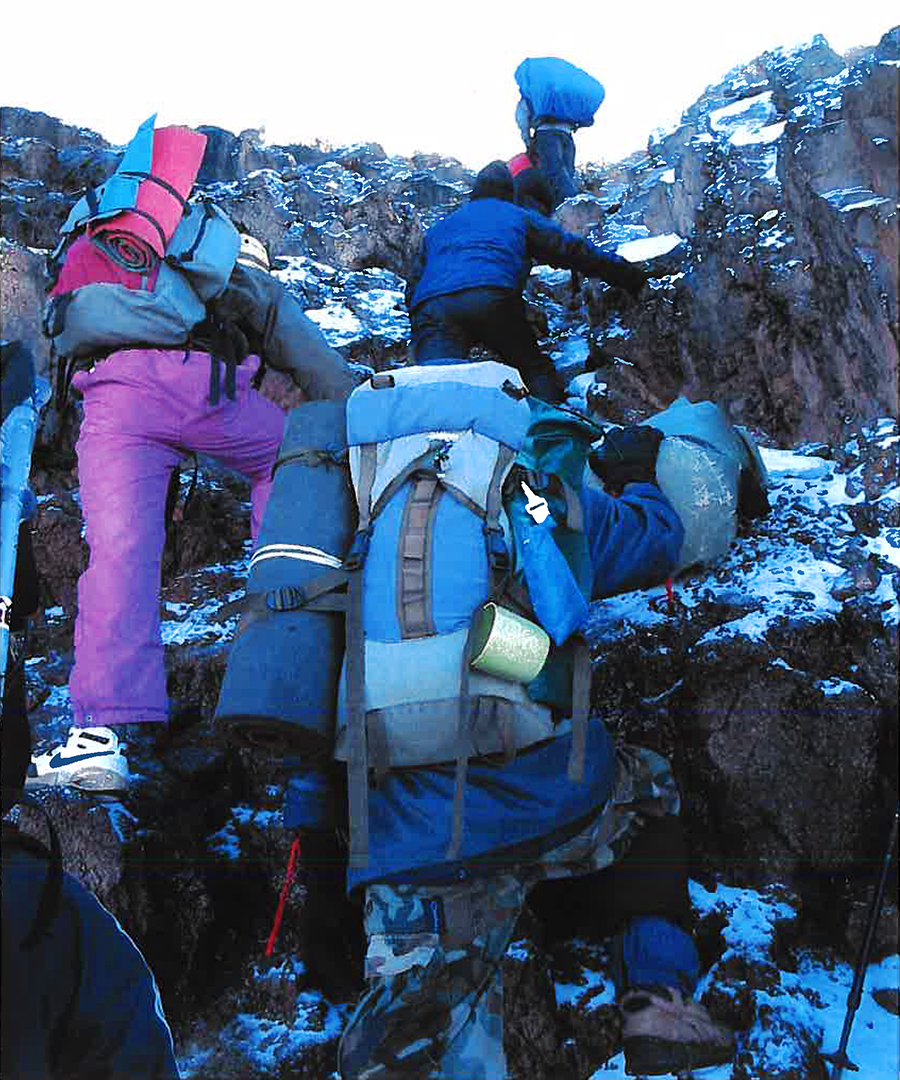
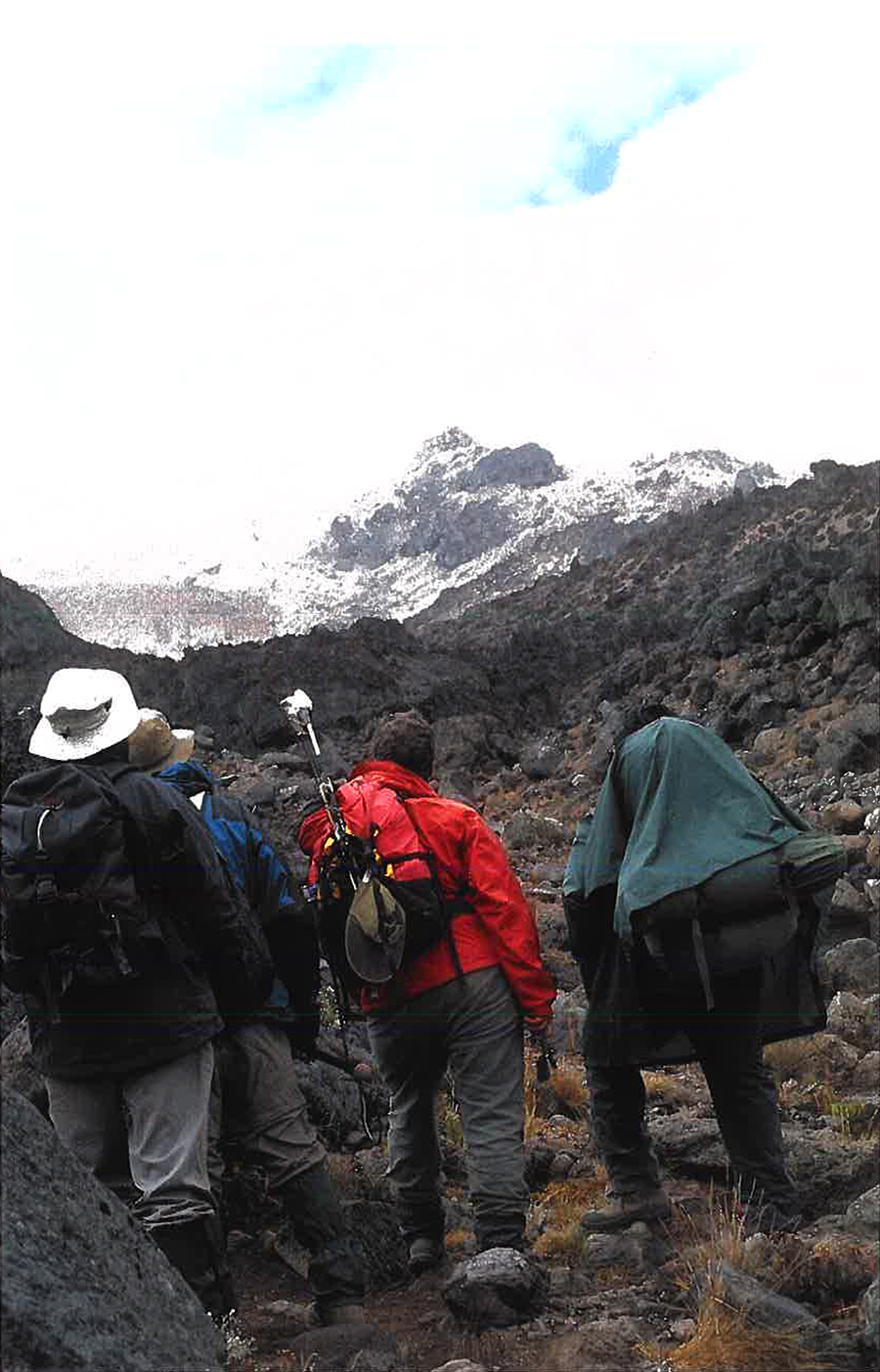
Finally, I am climbing up rock; we are off, after about three hours, the dreaded scree—some evil combination of loose dirt and rock that slips on each step—and we climb higher. An hour or two into these difficult and, I know, dangerous rocks, when you literally must test each grip and step before you commit, I begin to wonder when the dreaded Breach steps will appear.
I remember ominous tales of the vast, dangerous exposures and difficult “scrambles.” And, as I look right, I can see what look like the upward steps to the Wicked Witches’ Castle in the “Wizard of Oz” movie. These steps seem cut into a totally vertical wall, set out in a strange yellow tint but, I decide, no human could climb these evil things that may not even exist. That can’t be where we must go.
Suddenly, the rocks we are climbing on become steeper, more evil, and I realize something that jolts me—we are already on the existential Breach steps. Now, there is no route to defend. Only attack. No retreat. Only up.
For some reason, now, I remember Erick’s earlier advice about these steps: “Don’t think about the mountain, think about beer.” I take this to mean to forget about fear and focus like a champion athlete on what you’re doing now—not before, not later, but now. Helpfully, the concept of muscle memory that allowed me to get into shape quickly over two months takes hold.
The theory is that memory lies deep and dormant inside the muscles, even for decades, and can be retrieved with less effort than creating the memory from scratch.
Now, muscle memory makes me at once a hurdler, pole-vaulter, gymnast and football player. I’m running 14.1 in the National Decathlon Championships in Eugene, Oregon’s Hayward Stadium…vaulting 14’9″ in the NCAAs in Champaign, Illinois…pulling up on the rings in the Lenape Junior High gymnastic show…and running in high school through a broken field holding a football, looking for safe places to put my feet. My feet work to find scarce rocks that are partially embedded and that will hold.
There can be no major slip backwards—too dangerous—so I either fight for traction, playing running back from rock to rock, or re-create my gymnastic, pole-vault skills and pull up on the rock holds—testing, testing, testing each before I commit. This seems an especially important tactic as some rocks begin to slip, after which I move on, test, test, and commit to another.
Later, we all will admit to premonitions similar to the scene in Tom Sawyer when Tom and Huck attend, hovering silently, over their own funerals. Make no mistake. We four are at a dangerous place.
Suddenly, Andy is in trouble. He’s been going slowly ahead of me and stopping often—sometimes just as I’m in the middle of a scree-run, and I have to somehow re-create a starting momentum. Andy tells Erick he feels dizzy and is seeing stars—not in the sky, but in his head. Erick swoops to him like a corner man in boxing, looks at his eyes, feels his pack, which he pronounces “too heavy.” “Let me take several of your water bottles, they’re too heavy,” Erick offers.
And fatigue makes Erick’s suggestion palpable. “You’ll be fine. Tosha will spot behind you. David will go behind him.” Erick looks at me, at my eyes, and double-checks that I’m holding together. And we go on. Somehow, Erick’s look provides new strength.
Twenty minutes later, we’re still climbing. And I think back to a scene two hours ago when Andy, dangerously, began climbing scree too far to the left, on his own, on the Western Breach, and Erick yells to get back on the trail.
Later, we learn, this is where Andy’s fatigue set in—his moment of truth—and like a great athlete, which he was, and is, he simply keeps going, defying that great Lombardi saying: “Fatigue makes cowards of us all.”
Still later, we’ll learn Joel’s moment of truth was in bed with a bad stomach flu the night before our trip.
Mac’s was on the Breach and Crater top when Diamox helps him imagine a band waiting for him and playing very loud drums—only to realize he’s actually hearing the pounding of his own heart. And mine, my moment of truth, was that first night of tent-culture shock and an unshakable cough: The initial and unsleepable agony of not being able to get my breath at a paltry 8,950 feet.
Now, on the Breach, over 17,000 feet, my job is to climb anchor like a professional and to help coach Andy to the Crater floor. “Slow steps…small steps…lean in…slow…Coach Ted Nash would be proud…great job.” Unconsciously, several times, I say to Andy and tell him we’re almost there.
This is a trick I notice Erick uses with us constantly—I call it “We’re almost there…45 minutes…we’re already at 16,000…17,000…you look strong…” So I say all this and more to Andy: “Slow…small steps…you’re doing it…you’re almost there.”
Newfound confidence allows me to refuse Tosha’s hand to help pull me up a particularly hard scramble. I wave him off, check my grip, and pull up myself. At least for these hours, I’m a climber.
As we pull up higher and to more dangerous places, I remember stories that the Breach is actually an extremely difficult, highly “technical,” climb. The only thing that makes this untrue, they say, is the lack of a rope.
They are right. Once, Tosha comes back to check me on a difficult exposure and uses his light to spot the danger of a misstep, forcing me, momentarily, to break my vow of not looking down. And his orange beam shines thousands of feet below into a cold, deep, quiet blackness.
As we go higher, Tosha begins singing softly the Kilimanjaro song. I try to note to learn these words later.
Then, suddenly, we are up near the top to the Crater floor. We can see it. No useful exaggeration. Instantly, like a track coach, I switch tactics with Andy from “slow…slow…great job…” and move to the whip: “It’s time to go, Andy…go now…this is it…start your kick….” I’m amazed at how this verbal shift simply happens and how, groggily, Andy responds.
At this point, I’m sure Andy’s not even on this mountain, but back in his Penn Freshman Crew boat with Coach Ted Nash telling him it’s time to make his move.
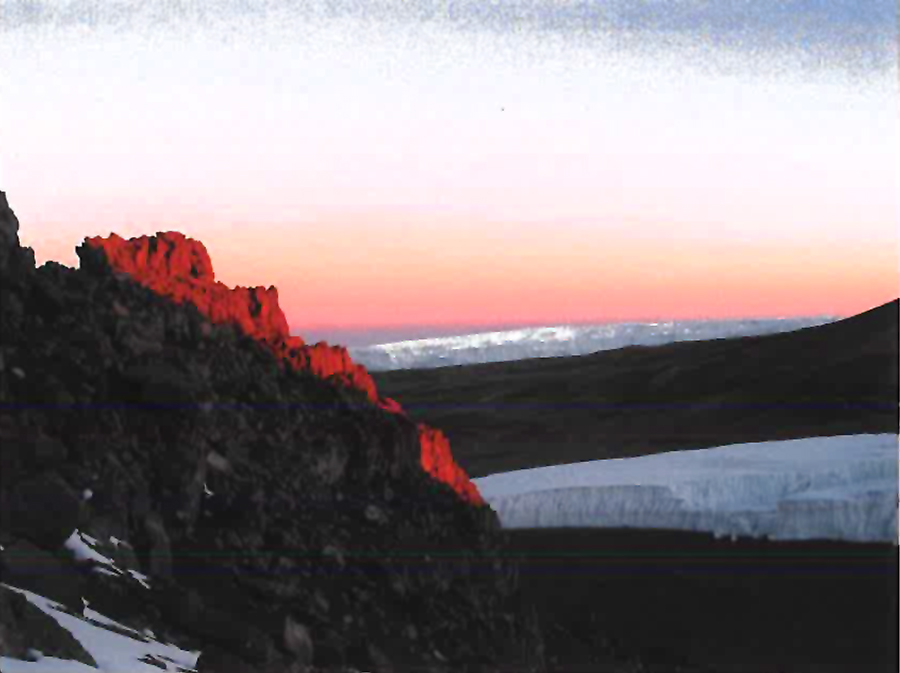
Then, as a warm shimmer of sunrise hits our backs, we are up over the dreaded Breach and onto the safe ground of the Crater floor. After Erick’s congratulatory handshake—or fist-bump through frozen gloves—we, for the first time, look back down onto the Empire State Buildings of scree and rock that we’ve just climbed.
Amazingly, my conditioning holds and, with extra rest and new-felt responsibility, I’m very much under control at 18,300 feet.
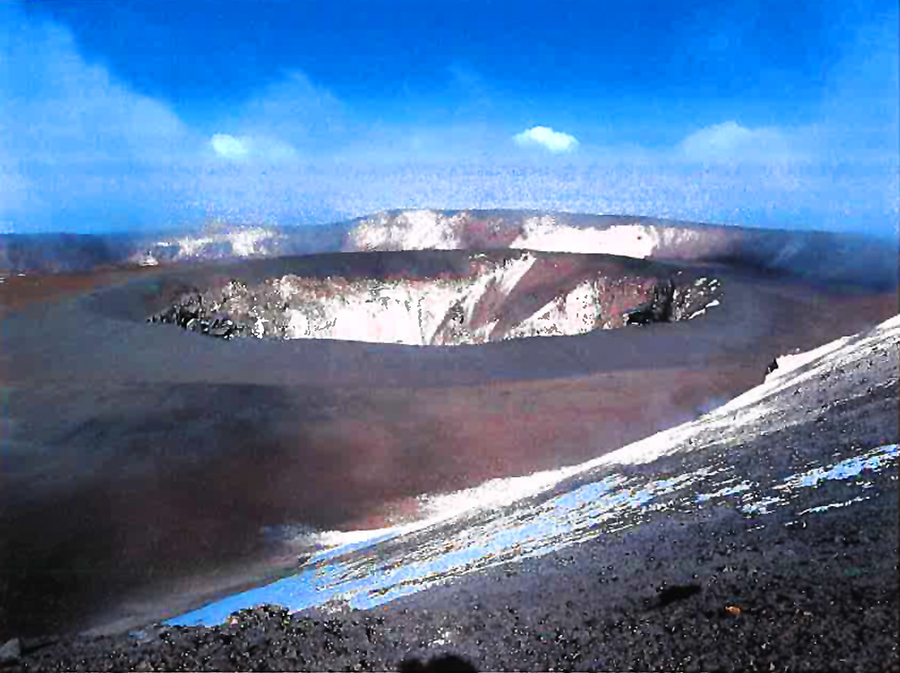
We walk the lost planet of the Crater floor past indescribable frozen-white glaciers and scenes of hot-orange sunrise. No man can live above 17,000 feet because, at this altitude, you begin to die. I feel exhilarated but, at the same time, as if I’m inside a strange passage of borrowed time here atop and within this Crater air that will slowly kill us.
We walk across what could be the end of the earth, this place that looks and smells of beauty and death, and we come to yet another hill. Erick points up and says confidently in his best useful exaggeration: “45 minutes to the Summit.” I feel good. But the group, especially Andy, can’t believe there’s more to go, more scree, more scrambling. Silently, I’m thankful to be under control to this last.
But, at this height, I know how fragile is physical strength. So we climb. This scree is easier. So is the scramble. I think back minutes ago to the scene of younger brother asking older brother to “lead the way by example,” and to Joel, trudging, forlornly ahead, past the end of his endurance but only beginning to draw down on willpower. I think back to Andy’s panic at seeing more scree and then his silent, slow, undefeated steps forward. To Mac’s talking continuously about his heart.
To Joel losing his sunglass lens and looking thankfully as I hand him an extra pair. And to Erick’s corner-man look into my eyes to see that I’m ready for one final round.
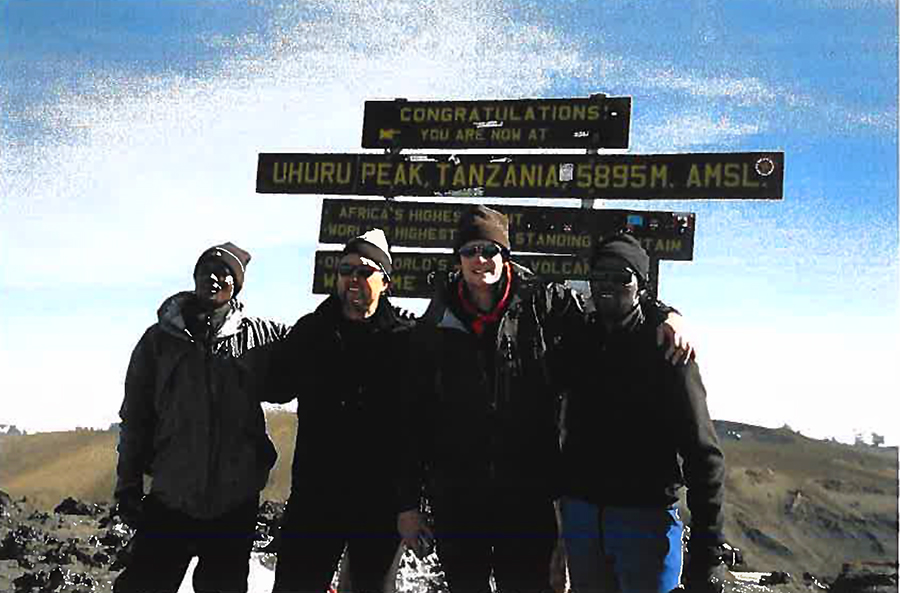
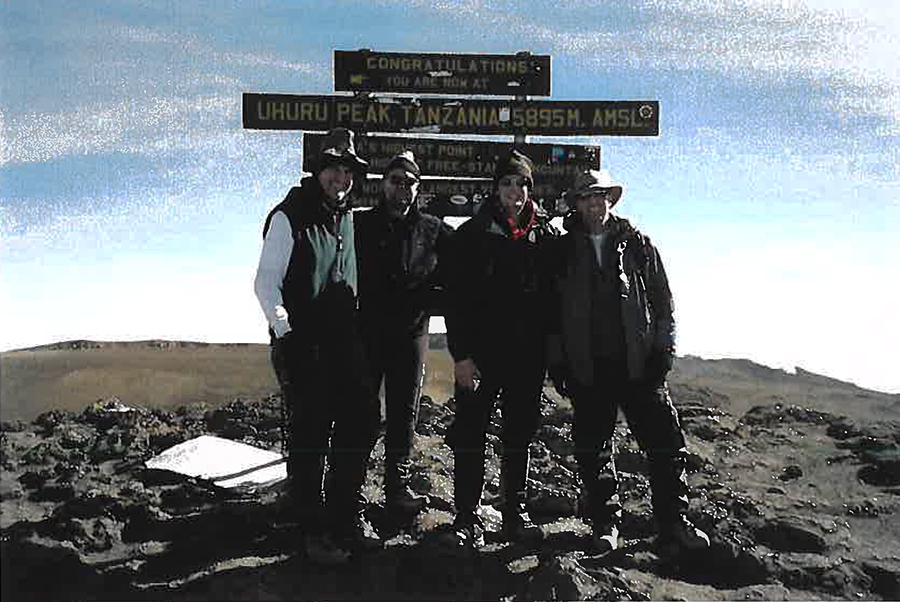
So we climb this last. And then we’re near. And then over the top to walk flat—flat—towards Uhuru Peak, the highest point in Africa, one of the world’s highest mountains, the highest free-standing mountain on the planet—to 19,340 feet.
It’s 8:25 a.m. and we are here. Joel, Mac and I walk slowly and Joel steps gently ahead. For most of the way, Joel has led by following Erick’s habitual and hypnotic steps and he leads now. Erick is waiting to hug me and I tell him I couldn’t have done it without him, and I hug Mac and Joel and later Andy and we absorb the reality that we are here on top of the world.
As a bunch of people gathers around the Uhuru sign, I am silently thankful we did not take the tourist routes, but rather the Western Breach. Today, we are true climbers. And a fortunate mix of adrenaline, guts, athleticism and willpower brought us all here. Atop the Summit, there is an indescribable emotional clarity about life, loved ones and the sense of what’s truly important. Later, Joel will talk about his vows.
And we’ll see one climber, Ken Merlo, who was always the lone American miles behind his British group. Late on one or two nights, near darkness, we’d see Ken stumbling toward camp and cheer him on like a champion. “They’re betting I won’t make the Summit,” he complained. “They’re betting against me.”
That proved a bad bet. Ken had been one of four partners in his company scheduled to present to Kantor Fitzgerald on the World Trade Center’s 101st floor at 8:00 a.m. on September 11. But that day, he had to run an errand. He would be a few minutes late. All three partners died. Ken lived. And now, he vowed, he was walking for them.
A few minutes later, we see a climber being led down by two guides, fast, almost running down the mountain’s gray-dirt descent trail between stopping for him to get sick. I think about this poor guy. But then I learn he’s made it to the Summit. Then I learn it was Ken Merlo.
As we leave the peak to, for the first time in days, actually go down, I begin to get emotional about loved ones and friends. It’s the emotional clarity of this mountaintop. A different consciousness. A different inner strength. A different place. The fact of the matter is we are all a little different from when we began.
We arrive now in a strange, large tent city that looks like a Depression-era version of The Grapes of Wrath at a midpoint down the mountain. The ten-hour hike down—down—the mountain is harder than I thought. Strangely, mentally, I was prepared to go up, but not down. At one point, I remember feeling the injustice of having to do one more hard scramble up a series of rocks…simply to go down.
After a total of seventeen hours of climbing, cross-signals between John, who has cooked, boiled, peeled and even bleached food to keep us alive for over a week, and Erick take us beyond one camp and into another—very, very thirsty, slow, tired.
Now, off the mountain, at our base camp hotel, we hear quiet whispers of death on the mountain. A young German man. Family gathers. At a nearby table, there is an older German woman sitting with people, but looking alone, staring. No one is talking. And so the last thing we can do today is celebrate our great victory over a mountain.
We four bonded brothers will never forget the deep, horrible pain behind the eyes of this German mother who has come to this place in Africa to bury her son. We say nothing.
We’re all back now, re-entered into our daily lives. At first, it’s hard. Like returning from the pages of a novel. Hardest is the daily anti-climax of any victory over threat, goal or mountain. Early on, for a few seconds, I remember strangely resenting the idea of balancing my checkbook. But then, gradually, I move further off the mountain and back into life.
Now, feeling a little like a football player who’s won the Super Bowl, I take weeks and weeks off from training. Joel and I meet in Washington but, at first, we feel somehow like we should be instead somewhere far away. Even looking at our climbing pictures, we don’t talk much about the mountain because it’s hard to talk about.
We talk to Mac. Andy and I reconnect to our great Olympic college coaches, me to Coach Irv “Moon” Mondschein, and he to Crew Coach Ted Nash, whose name and life lessons took Andy all the way to Kilimanjaro’s summit…and back.
Sometimes, now, the mountain feels like a dream. And every few days, I try and think back to what it means to go higher—to the passion of conquering fears, breaking habits and turning the routine into the unreasonable.
One day, Mac sends me a young, talented, impressive Middle East specialist who is looking for a job in Washington. He asks me about the mountain. And I find myself saying only: “It was a simple, life-changing experience.” He says Mac and Andy, back home in the heat and oxygen of Miami, don’t talk much about the mountain either. He says it reminds him of soldiers coming back from war. Joined by a mission, now bonded, but separate, from its completion. Four separate brothers re-charged by a war over an earthly mountain, Kilimanjaro, but still awed by the simple and magnificent beauty of our pilgrimage.